The Curse of the Luxor Hotel (Part 1)
Back in the 1990s, there were grand plans to make Las Vegas into a Disney World-type destination, full of ornate themed resorts and activities for children. The Luxor Hotel and Casino, an ancient Egyptian-themed hotel shaped like a giant obsidian pyramid with a beam of light coming out of the top, was bizarre, larger-than-life example of Vegas’ (brief) family-friendly ambitions.
Back in 2020, I released two episodes of my podcast about the history of the hotel, from its construction and grand opening to its current de-themed state, plus the stories behind why some people believe the hotel is cursed.
I saw them as fun, one-off episodes about a weird hotel that I stayed at once when I was a kid. But they’ve consistently been the most popular episodes of the podcast (and they tend to be in the first page of Google results for searches about the Luxor’s paranormal side), so I’d like to revisit this in this series of blog posts.
The Luxor has a strangely grim history, which—combined with the Egyptian theme that recalls urban legends about “mummy’s curses”—has led people to label the hotel itself as “cursed.”
I’ll tell you what, though: when I visited the hotel in 1995, just a few years after its grand opening, I absolutely loved it. Now, to be fair, I was a very young child, but I remember it fondly and feel a lot of nostalgia about the original version of the hotel. Of course, I stayed there during its glory days, before (most, if not all of) the tragedies that would mar the hotel’s image. (And before the de-theming that would literally ruin the hotel’s whole aesthetic.)
In this series, I’ll talk about the history of the hotel, what made it strange and unique, my experiences from when I stayed there as a kid (which unfortunately didn’t involve anything paranormal), the ghost stories, and what the hotel is like now.
The Luxor’s construction
Let’s start with the construction of the hotel itself: They built the casino and hotel in 18 months, for $375 million (which were drawn from Circus Circus’ petty cash). There’d been a trailer park on the location before the Luxor was built.
A delightful 27-minute promotional “documentary” on YouTube tells the story of the Luxor’s conception and construction. As someone who enjoys an in-depth behind-the-scenes look at any topic (but especially amusement parks and themed experiences), it’s possible that I’ve watched it a few times.
The featurette has a positive early ’90s vibe reminiscent of the behind-the-scenes videos that DVDs used to have. (The nostalgia!) They even interviewed some of the construction crew, who seemed excited to be working on something as novel as a pyramid.
The Luxor’s behind-the-scenes UFO connections
The video focuses mostly on the Luxor’s attractions. The late visual effects supervisor Douglas Trumbull designed the shows and theatres inside the hotel. He’d been responsible for the special effects for the films 2001: A Space Odyssey, Close Encounters of the Third Kind, Blade Runner, Star Trek: The Motion Picture, and Silent Running. So a real sci-fi guy. He also designed Back to the Future: The Ride at Disney.
Trumbull talked about how his work for the Luxor was the first time someone had let him really run free, designing everything from the films to the theaters they were shown in.
Under his direction, the Luxor commissioned a film/ride with moving seats featuring an ancient aliens-type story, where two people travel to see a highly technological civilization with spaceships and laser guns and such. Everything has a vaguely Egyptian-inspired theme (it gives me real Stargate vibes, just without the military sci-fi element.)
For the attractions, they made up a whole “architectural” style that they called “crypto-Egypto.” (I’m sure that sounded more cutesy and less loaded in the early 1990s.) The miniatures and sets for the shows were all really, really detailed. One of the sets had over 1,000 lights and the cameras were “computer controlled.” It was all very state-of-the-art 1990s tech.
That gives it a hilarious early ’90s tech time-capsule element. They talk about how each image in the CGI stuff is 90 MB of data, which they call “a computer worth of data.” (If you need a frame of reference for that, the mp3 of the last episode of my podcast was 41 MB.) The CGI team also talked about how they were using new technology and that the project would have been impossible even a year before.
Anyway, the original vision for the Luxor included an interconnected trilogy of films and live performances, which I don’t remember seeing and may have been too young for. But they were really investing their attractions.
I mentioned that the production had some weird little UFO-related connections. And yes, part of that is the fact that the Luxor had an ancient alien/science fiction themed attraction made by the guy who did SFX for a bunch of alien-related movies.
But while I was rewatching the making-of documentary this week, I caught something I’d missed when I originally watched it back in 2020.
When describing the SFX, they talk to the special effects supervisor, Joel Hynek. If you’re into UFO lore at all, that last name will ring a bell.
I immediately paused the video and do some searching, and sure enough: Oscar-winning visual effects artist Joel Hynek is the son of the famous UFOlogist J. Allen Hynek. (J. Allen Hynek was the person who came up with the “close encounter” classification of UFO encounters. He also consulted on Close Encounters of the Third Kind and had a cameo appearance in the film.)
I just thought that was a funny synchronicity: this strange hotel, which has attracted so much lore to it in the years since its construction, also attracted two people with connections to UFOs and the film Close Encounters of the Third Kind. That’s not exactly a shock, since it sounds like a cool project that allowed the creative team a lot of freedom to experiment. But it feels worth mentioning.
The opening of the Luxor
The year is 1993. On October 15, a massive crowd of 10,000 guests visited the hotel on opening day. To admire the new hotel’s splendor, theming, and attractions—including the Nile River boat ride that snaked around the lobby! Like I mentioned, it was part of the ’90s wave of kid-friendly, grand hotels that catered toward families and spared no expense.
Similar resorts that catered towards kids were the medieval-inspired Excalibur (the Luxor’s neighbor, opened in 1990) pirate-flavored Treasure Island (which also opened in 1993, and which you might remember from the climax of Miss Congeniality 2.)
Xanadu, the pyramid hotel that never was
One interesting synchronistic sidenote about the Luxor and Excalibur (which sits right next to the Luxor): Excalibur was built on a site that was originally going to feature the first themed mega-resort in Vegas. In 1976, developers planned to construct Xanadu, a hotel that would feature a pyramid design and would have cost $150 million to create.
Rather than looking Egyptian, this pyramid would have been more Aztec-style. It was intended to have 2,000 rooms, a 20-story atrium, and a flaming water feature.
However, the project ran into issues, perhaps financing problems or maybe issues with sewer line installations. I read different theories for what screwed up the project.
Since the site was immediately next to where the Luxor hotel was later built, I’d imagine that they never would have built the Luxor if the Xanadu had succeeded. Who needs two pyramid-shaped hotels next to each other? I also wonder whether the scuttled Xanadu project inspired the Luxor at all.
It’s particularly poignant that the failed project was called Xanadu; it was named after the capital of Kublai Khan’s empire. (There’s also that Coleridge poem about Xanadu.)
This hotel wasn’t the only troubled major project called Xanadu. There’s something strange, or maybe unlucky, about things called Xanadu. My strongest association with the word Xanadu is the American Dream Meadowlands mall in New Jersey, which was originally called Xanadu. The project began construction in 2004 and—because of various bankruptcies, construction issues, and changes in ownership—didn’t open until 2019.
And of course, in Citizen Kane, Charles Foster Kane’s massive, opulent, and lonely mansion was was called Xanadu. So not a name with a lot of positive associations.
I’ve always gotten the vibe that the idea of Xanadu represents opulence and destroyed splendor, which feels very a propos when it comes to Vegas (and Xanadu, and the Luxor)—and maybe America in general.
Look out for the next post, where I’ll continue my deep dive on the Luxor Las Vegas.
This article doesn’t link to sources as comprehensively as usual, because I wrote it based on my original episode notes, which I penned when I was worse at adding specific in-line citations. But all of the sources I used are linked at the bottom of the episode shownotes page. And I’m not proud of it, but I can tell you that a ton of this info is from Wikipedia.
The Curse of the Luxor Hotel (Part 2)
What does the Luxor look like?
Much of the lore about the Luxor’s supposed hauntings are inspired by the pure . . . strangeness . . . of the Luxor’s appearance.
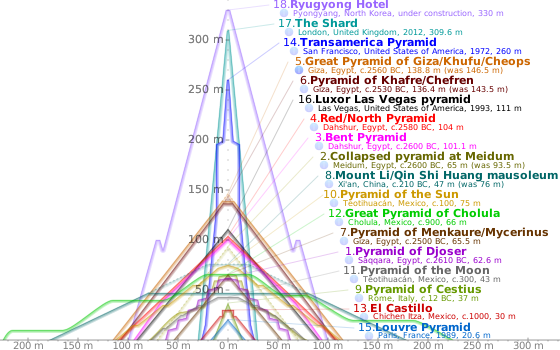
First off, the Egyptian-themed hotel is, of course, a pyramid. Named after Luxor (aka ancient city of Thebes), it’s about the same size of the Red Pyramid and Bent Pyramid in Egypt.
Put another way, the Luxor is 30 stories high—10 stories taller than the failed Xanadu project. At the time of its construction, it was one of the largest glass-and-metal structures that’d been built. It contains 11 acres of glass. My eyes glaze over when confronted with a bunch of numbers like this, but the visual effect of the hotel is certainly striking. Wikipedia has an amazing interactive image that compares the size of the Luxor to other pyramid-shaped buildings, and it’s close to the top.
When it first opened, there were 2,500 rooms, along with a 100,000 square foot casino.
The pyramid is topped with the world’s most powerful light, the Luxor Sky Beam. The illumination is so strong that you can see it from airplanes flying near LA. You can also see it from space. It’s 42.3 billion candela; one candela is about the equivalent of one normal wax candle, so it’s like . . . 42.3 billion candles.
When the lights are on, the temperature in the lamp room is 300 degrees F. Though the light has operated every night since the hotel opened, since 2008, they’ve only been lighting half the lamps to save money and electricity. Apparently the light even has its own ecosystem: it attracts months, which attracts bats and birds, which attract owls.
There’s also a single sphinx in front of the pyramid, which is actually larger than the actual sphinxes in Egypt. If they’d built it to proper scale, it would look too small next to the giant pyramid. So the sphinx is huge: 10 stories tall and as wide as 9 lanes of traffic.
There are over 100 “computerized fountains” in front, with laser beams that come out of the sphinx’s eyes to project onto a water screen. Because of course there are.
The carpet in the Luxor could cover 34 football fields. At the time of its construction, the atrium of the Luxor was the largest in the world. Apparently, nine 747s could be stacked on top of each other in the lobby.
Because the exterior walls are, of course, built at a slant, the elevators, or “inclinators” as they called them, had to go up at a 39-degree-angle along the sloped slides of the pyramid.
The rooms also have angled interior walls; they exit out onto hallways that look straight down over the atrium. So you can step out of your room and look down at all the cool stuff below. (Remember that architectural detail: it’ll be important later in this series.)
The Nile River ride!!!
When they opened, there was also a Nile river ride, which I remember making my parents go on a number of times back in 1995, when I was a small child. I really, really liked that ride.
The original idea behind the river ride was to take people from the check-in desk to the inclinators so they could go upstairs.
Now, that’s a level of excess that I find charming. It’s what someone would come up with if they had all the money in the world to build a weird, wild, intense themed hotel. Which doesn’t seem too off the mark.
I think that’s what I like so much about the Luxor—they really went for it. It’s lost some of its shine since then, but at one point, it was a bit of a moonshot.
I’m not saying that what Vegas stands for is great or that huge corporate construction projects are good, necessarily, but the original vision for the Luxor stands in stark contrast to how even (especially) the richest companies nowadays are famous for shaving every cent off project costs to maximize profits. Like, maybe there was a time when building something “cool” mattered. Even if the “cool” thing is a tacky hotel in Vegas. (And the disclaimer here is that I see the Luxor through big ol’ nostalgia goggles.)
(To reference another thing from 1993, when I think of the Luxor, all I can think of is the scene in Jurassic Park when John Hammond is bragging about how no expense was spared.)
Anyway, in the end, the Nile ride was a sort of faux-archaeological tour. It would wind around the lobby on the river while the tour guide talked about some of their reproductions of Egyptian sites and artifacts.
One highlight I remember from when I was there: at one point there was a bridge with a waterfall that the boat passed under, and it was timed so that the waterfall stopped right before you went under it. The tour guide would say if a drop of water fell on you there, it was good luck. I don’t know why, but my child brain was particularly charmed by that.
There was a really impressive attention to detail in terms of the ancient Egyptian stuff in the hotel lobby, including a recreation of a temple of Isis from 50 BC, as well as the statues at Abu Simbel, and a replica of King Tut’s Tomb. (I really liked the tomb recreation. So much fake gold!)
I also recall a pair of talking animatronic camels.
In 1996, there was a $240 million expansion of the Luxor, which added a Imax theatre, ice rink, and laser light show. (Sadly, I believe that they also got rid of the earlier sci-fi Egyptian films and rides to make room for those.)
And then in 1998, they added 2,000 rooms in ziggurat-style towers, for $675 million. It’s wild that the first expansion cost 2/3 as much as the initial construction, and then the second addition cost almost double–that seems really weird.
The behind-the-scenes video that I mentioned in the last post, which talks all about the Luxor’s splendors, is so positive. They quote someone saying “This place will never close, it’ll be here forever, it’ll be open twenty-four hours a day.”
Well, that might be a foolish and fate-tempting thing to say about an Ancient Egyptian-themed hotel.
Check out the rest of this series about the history and hauntings of the Luxor hotel:
This article doesn’t link to sources as comprehensively as usual, because I wrote it based on my original episode notes, which I penned when I was worse at adding specific in-line citations. But all of the sources I used are linked at the bottom of the episode shownotes page. And I’m not proud of it, but I can tell you that a ton of this info is from Wikipedia.
The Curse of the Luxor Hotel (Part 3)
De-theming
The last couple days, I’ve talked about some of my nostalgia the Luxor (as it was when I visited in 1995) and some of the original aspirations and creativity behind the now-believed-to-be-cursed hotel.
Las Vegas itself has changed since the early ‘90s. After the foray into themed resorts and family-friendly splendor, it was decided that gambling and drinking was better business. I imagine the margin on casinos is way, way, better than the margin on free Nile river board rides and overpriced kids’ menus. Because of that, the “family fun” parts of Vegas were phased out.
I mentioned Treasure Island, before—if you’ve seen Miss Congeniality 2, you may remember that the resort hosted a nightly pirate-themed show there back in the 1990s and early 2000s. (I remember seeing it and thinking it was cool.)
Well, in 2003, Treasure Island took out that show and replaced it with what the president of the casino called a “sexy and beautiful, adult Broadway-caliber show.” I don’t really know why he seems to think that Broadway provides adult entertainment—maybe he’s thinking of the old Times Square before that got Disney-ified, but whatever. It sounds like the hotel’s owners realized that kid-friendly pirate stuff may not appeal to adults looking to party and lose a bunch of money at casinos.
Also, around the time of the revamp, Treasure Island rebranded as “TI,” which seems really weird to me, because 1) it just makes me think of the rapper, and 2) it isn’t memorable and doesn’t really say anything, whereas at least Treasure Island fits with the casino’s theme.
In 2013, the “Sirens of TI”–the adult version of the show–was shut down and replaced by a shopping and entertainment center with a CVS as the anchor tenant.
So sounds like Vegas has gone the way that NYC has—take out everything interesting and replace it with a CVS.
(Ready for a NYC-related digression? Despite living a couple subway stops away from Manhattan, I only go aboveground there every couple months—mostly I just pass through on my way between Queens and Brooklyn. Manhattan is mostly offices, bank branches, drugstores, and empty storefronts these days; it’s been hit by the same profit-driven impulses that Vegas has. Price out everything cool and unique and replace it with whichever bland tenant can pay the highest rent. It’s a real bummer and it seems to strike everywhere.)
Likewise, Excalibur has gone through a similar de-theming and emblandening. The hotel once featured a statue of Merlin on a high turret of the castle. It was cool and went well with the dinky Merlin-fighting-a-dragon pyrotechnics show that happened hourly outside at the castle moat. Well, they shut down the attraction in 2004 and in 2007, they replaced the Merlin statue in the tower an advertisement for Dick’s Last Resort.
As for the rest of the Excalibur: Starting in 2006, they started removing the medieval themes, most of which were gone by 2010. Come on, it’s a tacky castle-shaped hotel! Why not lean into that? You’re not gonna be able to get people to forget they’re in a large, brightly-colored castle, even if you take away all the fun bits.
The Luxor today
Sadly, the same thing happened with the Luxor.
The Luxor had been built by the Circus Circus Enterprises, but was purchased by MGM Resorts International in 2005. In July 2007, the new owners spent $300 million—almost as much as Circus Circus spent to build the hotel in the first place—to renovate 80% of the Luxor’s public areas. They stripped out the Egyptian theming and replaced it with generic-feeling, kinda seedy-looking restaurants, bars, and lounges.
There are two shows at the Luxor these days: a topless show called “Fantasy” and a Carrot Top comedy show. There’s also a club on the casino floor called “Cathouse.” I’m not here to judge various forms of entertainment, but thematically and philosophically, it’s a far cry from painstaking reproductions of King Tut’s tomb.
Sadly, the Nile River ride that I loved so much as a kid was only open for three years, from 1993-1996. After that, they drained the river ride and filled it in to have more public walking space.
I started this series talking about that sweet, sweet early ’90s optimism that characterized the Luxor’s creation. The cutting-edge technology that bragged about using to create those attractions seems quaint and extremely dated by our standards, and those attractions are closed now anyway. The Luxor has lost its shine. (Though not literally; the Sky Beam is still going strong, as far as I’m aware.)
One concrete example of how the Luxor is valued these days: It’s wild how cheap it can be to stay at the Luxor. As of writing this (in May 2023), the cheapest room rates range from $30-$200, depending on what nights you want to stay there. Double digits for a hotel room is just, you know . . . real cheap.
(Probably false) rumors about the Luxor’s future
When I first released my podcast episodes about the Luxor in late 2020, I saw that during summer 2020, rumors had started flying that the Luxor was being considered for demolition.
Well, I’m happy to say that the hotel’s still around. Interestingly, I was reading some articles about the supposed demolition a month or so before writing the original episode scripts, and I found that several of the articles had become dead links by the time I recorded (though I still found a few sites from July 2020 that address the rumor that the Luxor, and possibly the Excalibur, may be torn down.)
I know the games industry is extremely powerful, so I don’t know if financial pressure or something else brought down the original articles I read, but just to be clear: I’m just repeating a rumor, and the fact that the original articles have been taken down make me think it may have been a false rumor, or at least a killed one. I feel a little skeptical of those 2020 claims that the hotels would be more valuable if they just didn’t exist. It doesn’t really seem like a great time to tear down a couple hotels and then spend probably a billion dollars building new ones, though what do I know?
The now-removed article on VitalVegas.com, which I found on archive.org, said:
De-theming casinos in Las Vegas has happened fairly frequently in recent years, as the perception of themes has evolved from cool to kitschy (or downright tacky) over time.
Many changes have already been made at Luxor to move away from its original theme, but it’s virtually impossible to re-imagine a massive pyramid.
The same dilemma is faced by Excalibur. Good luck tweaking a castle.
Our sources say company officials have discussed demolition of both Luxor and Excalibur for at least five years, but have been unable to proceed due to union contracts. It’s possible the COVID-19 shutdown has paved the way for what’s to come for Luxor.
Like I said, I don’t know that I believe the rumors. But there are tons of stories of old classic Vegas hotels like the Sands, Riviera, and Stardust being demolished. Also around 2020, there were false rumors of demolitions of other hotels, like the Rio. But at any rate, the Luxor hotel today is a far cry from its original beginnings as an experience to rival a theme park.
Outro
Alright, that’s enough about the history of the hotel.
Tomorrow’s blog post will be the text version of the podcast episode that drops tomorrow, but I’ll be back next week with tales about the creepy side of the Luxor.
Let me just say . . . there seem to be some real bad vibes there nowadays.
Check out the rest of this series about the history and hauntings of the Luxor hotel:
- Part 1: creative vision and Xanadu
- Part 2: the glory days and the legendary (according to me when I was a child) Nile River ride
This article doesn’t link to sources as comprehensively as usual, because I wrote it based on my original episode notes, which I penned when I was worse at adding specific in-line citations. But all of the sources I used are linked at the bottom of the episode shownotes page. And I’m not proud of it, but I can tell you that a ton of this info is from Wikipedia.
The Curse of the Luxor Hotel (Part 4)
Content note: this one gets slightly gruesome, with mentions of that creepy Bodies exhibit.
Despite my fond memories of the Luxor, it seems like there’s some bad vibes at there; that much is clear.
Also, I doubt it helps that the Luxor is also host to two exhibits:
The first is the “Bodies” exhibit that was so popular in the late 2000s. To be clear, the Vegas exhibit isn’t the only one. I remember back in, say 2005-2008, there were tons and tons of “Bodies” exhibits all over the world. The Luxor got a permanent version of the “Bodies” exhibit in 2009.
In case you haven’t heard of it, it’s an exhibit shows real human bodies that have had the skin stripped off, preserved using a method called plastination, and then dissected and displayed in different stages. Like for example, posted like they’re running, or playing tennis, etc.
There are some major issues with the “Bodies” exhibit, aside from it being . . . an awfully creepy and gruesome display of real human bodies. Human rights advocates have raised concerns that the bodies may have been gathered from executed Chinese political prisoners, without the consent of the prisoners and their families.
Wikipedia points out that the archived exhibition page included a gruesome disclaimer:
This exhibit displays human remains of Chinese citizens or residents which were originally received by the Chinese Bureau of Police. The Chinese Bureau of Police may receive bodies from Chinese prisons. Premier cannot independently verify that the human remains you are viewing are not those of persons who were incarcerated in Chinese prisons. . . . Premier relies solely on the representations of its Chinese partners and cannot independently verify that they do not belong to persons executed while incarcerated in Chinese prisons.
(That was from the 2008 version of the site; the disclaimer has since been removed.)
A 2006 NPR story said:
Dr. Gunther von Hagens, the inventor of plastination and the impresario behind the Body Worlds exhibitions, says that every whole body exhibited in North America comes from fully informed European and American donors, who gave permission, in writing, for their bodies to be displayed. The science museums that have hosted Body Worlds also make this assurance.
“What I certainly never use for public exhibitions are unclaimed bodies, prisoners, bodies from mental institutions and executed prisoners,” von Hagens says.
Chinese medical schools supply von Hagens with unclaimed bodies, which he plastinates and sells to universities. Von Hagens used to take cadavers from the former Soviet Union, but he stopped after body-trafficking scandals in Russia and the Kyrgyz Republic.
Five years ago, customs officers intercepted 56 bodies and hundreds of brain samples sent from the Novosibirsk Medical Academy to von Hagens’ lab in Heidelberg, Germany. The cadavers were traced to a Russian medical examiner who was convicted last year of illegally selling the bodies of homeless people, prisoners and indigent hospital patients.
Von Hagens was not charged with any wrongdoing, and says his cadavers are obtained only through proper legal and ethical channels.
Still, NPR has learned there’s no clear paper trail from willing donors to exhibited bodies.”
A number of religious groups, as well as bioethicists, have objected to the concept in general. There’s something really sick about paying money to look at exhibits of human bodies, put out on display, especially when the company that put on the exhibit hasn’t been able to come up with consent documentation for the people who are on display.
After the 2020 COVID shutdown, The Bodies exhibit reopened with updated displays showing the effects of COVID on the human body.
And if the questionably sourced bodies obtained by a creepy German doctor aren’t enough for you, there’s also a Titanic exhibit that includes more than 250 artifacts from the wreck, including, to quote the exhibit’s website “luggage, the ship’s whistles, floor tiles from the first-class smoking room, a window frame from the Verandah Cafe and an unopened bottle of champagne with a 1900 vintage.”
The exhibit looks pretty cool, but, you know, if we’re looking for possible reasons why people might think the hotel is haunted, the fact that there are two major exhibits that focus on death and disaster could have something to do with it.
And I’ve only just begun enumerating some of the theories behind the supposed “Luxor Curse.”
Check out the rest of this series about the history and hauntings of the Luxor hotel:
- Part 1: creative vision and Xanadu
- Part 2: the glory days and the legendary (according to me when I was a child) Nile River ride
- Part 3: De-theming sucks
This article doesn’t link to sources as comprehensively as usual, because I wrote it based on my original episode notes, which I penned when I was worse at adding specific in-line citations. But all of the sources I used are linked at the bottom of the episode shownotes page. And I’m not proud of it, but I can tell you that a ton of this info is from Wikipedia.
The Curse of the Luxor Hotel (Part 5)
Content note: this post contains mention of suicide and guns.
Over the last week or so, I’ve talked about the Luxor Hotel’s history and shifting identity, but I haven’t talked at all about the strange, tragic, and potentially paranormal elements of the hotel’s history.
So let’s get into the more urban legends parts of this story, which means of course that it’s time to talk about some rumored suicides (so content warning for that).
While I love urban legends and stories of hauntings, I find most of them, including these, very suspect
Why are some hotels haunted?
To talk about a different haunted hotel that I’ve stayed at: in early 2020, I stayed at the Hawthorne Hotel in Salem. In the podcast episodes I did about that experience, I talked about how so much stuff had happened there.
It wasn’t just one story: it seemed like the hotel, or the site that the hotel was on, had attracted an unusually large number of strange things, and maybe the collective energy of all of that had something to do with hauntings.
I feel similarly about the Luxor—there’s no single thing that really makes me feel that it’s definitely haunted, but more like a bunch of different details that seem to weirdly converge at the Luxor.
So many souls
The intersection that Excalibur and Luxor sit, where Tropicana and Las Vegas Boulevard meet, apparently has the most hotel rooms of any intersection in the world. That’s a lot of lives and souls moving through there, and in a place like Vegas, where people travel to party and often lose huge sums of money, it seems like there could be an awful lot of psychic upset and human pain there.
They say that what happens in Vegas stays in Vegas, and maybe that saying applies to ghosts, too.
Dying in Vegas
I know that suicides are pretty common in Vegas, and a lot of desperate people go there to try to win something with their last dollars. They’re so common that there’s supposedly a widespread policy that if you shoot yourself in your hotel room and cause damage to the room or furniture, your estate will be billed for the damage.
Also, some websites claimed that every time someone dies in a Vegas hotel room, that room has to be quarantined for 2 weeks, which hotels don’t want to have to do. Because of that many hotels allegedly move bodies to other areas of the hotel before calling the cops, so they don’t have to go through the trouble of closing up the room for 2 weeks.
But, hey, the good news is that if you die in a Vegas hotel and it’s not a suicide, the standard practice is to comp the room.
Death and the Luxor
Here’s what VitalVegas.com had to say about Vegas deaths; they called out the Luxor specifically:
Some of the most gruesome suicides happen off of hotel balconies and parking garages, but the absolute winner in the area of ghastly suicides has to be the Luxor. Why’s that? Well, because if you jump from a balcony or parking garage, you land outside. At Luxor, because of its pyramid design, jumpers jump inside the building, into the casino and reception area.
And as if that wasn’t enough, supposedly the Luxor was built on the site of a burial ground for mob victims. Bestofvegas.com claims:
Another possible reason for ghost sightings at the Luxor have to do with the much talked about “holes” in Las Vegas. The term “holes on the Strip” refers to the fact that years ago the town was laced with mobsters who supposedly buried bodies all along the south end of the Strip because at the time there were no buildings there. The Luxor is said to have been built on top of a popular burial site.
Who knows how accurate these urban legends are. But true or not, they certainly add to the general vibe and narrative of the Luxor being “cursed.”
Check out the rest of this series about the history and hauntings of the Luxor hotel:
- Part 1: creative vision and Xanadu
- Part 2: the glory days and the legendary (according to me when I was a child) Nile River ride
- Part 3: De-theming sucks
- Part 4: The skeletons aren’t even in the closet
This article doesn’t link to sources as comprehensively as usual, because I wrote it based on my original episode notes, which I penned when I was worse at adding specific in-line citations. But all of the sources I used are linked at the bottom of the episode shownotes page. And I’m not proud of it, but I can tell you that a ton of this info is from Wikipedia.
The Curse of the Luxor Hotel (Part 6)
The Luxor’s construction
Some folks online pointed out that the Luxor was built very quickly (in 18 months) and cheaply (it cost almost as much to renovate it as it did to build it.) So who knows, maybe some corners were cut. And maybe that chaotic beginning might have left some sort of mark on the supposedly “cursed” hotel.
The hotel wasn’t totally done being built when it opened, actually. Some of the first guests stayed in rooms that weren’t quite completed. And there were issues with the elevators, or, as they called them, “inclinators”
Shortly after opening, the owners learned that the hotel was sinking into the sand and had to make adjustments to stop it. Apparently there was a soft spot under a bit of the hotel, which is pretty unusual—I guess the desert floor is usually pretty hard. But that wasn’t the only problem that would come up.
Structural issues
According to an archived September 2010 article in the Las Vegas Review-Journal, there’d been a number of structural problems with Vegas resorts, and a lot of Vegas renovations had been done without permits.
It sounds like that prompted a number of investigations of different resorts, and a routine inspection may have unearthed something strange at the Luxor:
The Clark County building division in mid-July ordered the Luxor to vacate a section of the pyramid building’s basement level, which holds various offices not open to the public. The order came after Lochsa Engineering did a study for MGM Resorts International, which owns the hotel-casino. MGM hired the firm when county inspectors, in March, found two unfinished support columns in the pyramid’s basement.
Lochsa determined the two unfinished columns were not part of the building’s original plans. But MGM completed the columns anyway and is now evaluating how to further strengthen the structure. Lochsa also looked at the “load bearing capacity” of the pyramid’s casino level — which is over the basement.
The basement closure is below, but “near the main entrance of the subject property,” according to the county’s July 16 notice of violation. The document says completion of the two “partially cast concrete columns … will not fully resolve the structural repair requirements” for the casino level’s “deficient slab.” . . .
To date, the Luxor’s ongoing inspection has generated 1,129 correction notices and notices of violation, according to a search of the county’s website. Items range from the great — such as the casino slab problem — to small points of maintenance”
Construction worker deaths
On a now-defunct page on casino.org that I had to dig up in the Wayback Machine, as I did for many of my sources here, I found some interesting rumors.
Supposedly, seven construction workers died when the Luxor was originally built, though elsewhere I read that three workers died. That, to me, seems not particularly unusual, though, again, what do I know.
Here’s my frame of reference for construction deaths, though:
- 5 people died when building the Empire State Building
- More than 30,000 people died building the Panama Canal
- 11 people died during construction for the Rio de Janeiro Olympics
- World Trade Center construction resulted in 60 worker deaths
- 5 workers died while building The Sears Tower
- 6 people died building Las Vegas’ CityCenter project
- 28 people died while building San Francisco’s Bay Bridge
So to me, I’m hearing that construction work is extremely dangerous. Maybe there are legends of all of those places being haunted, but if that’s the case, then most major building projects would be haunted by the ghosts of construction workers
Vegasghosts.com claims:
Perhaps significantly due to the main pyramid’s steeply sloping shapes, the Luxor’s construction is considered to have been extremely difficult and dangerous. The resort’s construction may very well remain the most treacherous construction process in the history of the Strip. The fallen workers have not gone completely forgotten, however. At times, especially in quiet parts of the hotel, the ghosts of the construction workers can be seen. When the Luxor’s Nile Riverboat ride was still operational, some guests claimed to have seen their ghosts roaming the tunnels.
Also, in the YouTube comments section of the behind-the-scenes making of the Luxor video, the child of one of the foremen who did concrete work on the Luxor mentioned that “few floors collapsed while they were pouring concrete. I remember my father telling me about it when I was a kid.” They don’t mention deaths, though.
Check out the rest of this series about the history and hauntings of the Luxor hotel:
- Part 1: creative vision and Xanadu
- Part 2: the glory days and the legendary (according to me when I was a child) Nile River ride
- Part 3: De-theming sucks
- Part 4: The skeletons aren’t even in the closet
- Part 5: Death and hauntings
This article doesn’t link to sources as comprehensively as usual, because I wrote it based on my original episode notes, which I penned when I was worse at adding specific in-line citations. But all of the sources I used are linked at the bottom of the episode shownotes page. And I’m not proud of it, but I can tell you that a ton of this info is from Wikipedia.
The Curse of the Luxor Hotel (Part 7)
Check out the rest of my look at the legends surrounding the Luxor Hotel: part 1, part 2, part 3, part 4, part 5, part 6
Content note: this post contains mentions of death, suicide (including the methods in which people died), mass shooting, domestic violence, and a bombing.
There are plenty of reasons why the Luxor has gained a reputation for being haunted. Chief among them: the amount of death and violence that have occurred at or near the hotel.
To start us off on tragedies related to the Luxor: Tupac Shakur was staying at the Luxor on the night he was killed in 1996 (though he didn’t die at the Luxor).
Death in the atrium
Supposedly two guests have killed themselves by jumping into the Luxor’s atrium. Like I mentioned earlier in this series, the rooms open out around the 30-story-tall atrium.
In 1996, the first guest who apparently died this way. A woman, who some people claimed was a sex worker, jumped from the 26th floor and died. She landed right where the buffet was then; the food court stands where she landed.
Some ghost tours have apparently claimed that they tore out the old buffet because of fear of contamination, but my guess is that they prob just wanted to freshen up the place–it’s too gruesome to eat at the buffet where someone died.
The Las Vegas Sun called it a suicide. To read from the September 1996 article about the woman’s death:
Police have “no idea who she is,” Keeton said. She appeared to be a Hispanic or Asian woman in her 30s. She did not have a purse or identification with her, he said.
The coroner’s office is using fingerprints and dental records to attempt to identify her, a spokeswoman said today.
Plenty of (probably false) rumors have sprung up around her death. Some people claim that she’d just gotten an HIV diagnosis so killed herself, though I don’t know how people would know that if they couldn’t identify her—that sounds made up.
Another guest supposedly died falling from the 10th floor of the Luxor. It didn’t sound like it was a . . . voluntary . . . death. He supposedly landed on the express check out counter, which has since been moved
The bombing
In May 2007, a homemade pipe bomb went off in the parking garage of the Luxor. One 24-year-old man died; he’d been a worker at the Nathan’s hot dog stand in the Luxor’s food court.
The bomb was underneath an upside-down plastic cup; when the worker picked up the cup, it exploded.
It seems that this man was intentionally targeted, though it’s unclear why. Two men were arrested for the bombing and put in prison for life with no chance of parole.
After the bombing, the hotel wasn’t evacuated and operations didn’t stop at all–it doesn’t seem like the explosion had an impact outside of the garage, and it didn’t damage the building at all.
An altercation
In 2010, a former football player from the University of Nevada, Las Vegas tried to intervene in a physical altercation between another guest—a friend of his who happened to be an MMA fighter—and the fighter’s girlfriend. The MMA fighter was drunk and angry, and grabbed his girlfriend by the neck and hit her.
The football player intervened, trying to restrain the MMA fighter, who ended up brutally assaulting and killing him. He never work up again, but later a court claimed that the football player died of an overdose, not from the fight. Which is . . . weird. But at any rate, it’s another tragedy associated with the Luxor.
Deaths in 2012
In 2012, a casino employee was murdered by her boyfriend in the hotel’s lobby.
Also in 2012, a hotel guest died of Legionnaires disease. This was the third case of the disease, apparently, but wasn’t caught because water tests came back negative. After the guest died, the tests came back positive.
Again, in 2012, an airman visiting from a nearby Air Force base fell 25 feet down an elevator shaft. He’d gotten into a fight with a colleague in the lobby of the west tower, and was pushed against the elevator door. For some reason, the doors opened onto the empty elevator shaft. He fell to his death.
A tiny sidenote: The next year, in 2013, lightning struck the Luxor Hotel and Mandalay Bay, during a storm that made 33,000 people lose power and that saw 740 cloud-to-ground lightning strikes in 3 hours.
The Mandalay Bay Hotel mass shooting
You might remember the shooting that killed 60 people and injured 411 people at the Mandalay Bay Hotel back in 2017, during a concert.
That happened so close to the Luxor that during the shooting, authorities couldn’t tell if the shots were coming from the Mandalay Bay or Luxor
By the way, there are (predictably) plenty of conspiracy theories about the shooting, seeking to link it to the illuminati, government programs like MKULTRA. I don’t put any stock in these theories, but it’s interesting to see the ways in which the hotel’s appearance attracts speculation and conspiracy thinking.
From illuminatiwatcher.com:
The Luxor is known as the Egyptian themed casino with the pyramid that has the illuminated apex and obelisk nearby. These symbols are of great usage to the “Illuminati” who subscribe to many of the magickal and esoteric concepts of ancient Egypt and its mystery schools that shared these ideas only to the initiates deemed worthy.
Check out the rest of this series about the history and hauntings of the Luxor hotel:
- Part 1: creative vision and Xanadu
- Part 2: the glory days and the legendary (according to me when I was a child) Nile River ride
- Part 3: De-theming sucks
- Part 4: The skeletons aren’t even in the closet
- Part 5: Death and hauntings
- Part 6: Construction woes
This article doesn’t link to sources as comprehensively as usual, because I wrote it based on my original episode notes, which I penned when I was worse at adding specific in-line citations. But all of the sources I used are linked at the bottom of the episode shownotes page. And I’m not proud of it, but I can tell you that a ton of this info is from Wikipedia.
The Curse of the Luxor Hotel (Part 8)
Check out the rest of my look at the legends surrounding the Luxor Hotel: part 1, part 2, part 3, part 4, part 5, part 6, part 7
Yesterday, I mentioned that the Luxor’s pyramid shape worked upon people’s imaginations, encouraging them to construct occult lore around the place. I’d like to dig into that a bit more and look at some of the proposed “solutions” to the Luxor’s “curse” that I’ve seen people bandy about online.
Pyramid paranoia
The Luxor’s Egyptian theme seems to invite speculation. Even in its de-themed state, it’s still a mysterious-looking building.
Maybe it has to do with how it’s a huge black glass pyramid with the brightest beam of light on earth coming out of the top? It’s a really weird structure, when you think about it.
Some folks say that the pyramid’s shape attracts dark energy, and that an eye needs to be placed at the top of the pyramid to counteract the curse.
I don’t get that, really, since the Eye of Providence or all-seeing eye has such a strong connection to things like the dollar bill, freemasonry, and Christianity, but not to ancient Egypt, to my knowledge. (There is the eye of Horus in ancient Egyptian symbolism, but that didn’t crown the pyramids or anything.)
Historical accuracy
Some people say that the pyramid should have been more accurate. Supposedly, in ancient Egypt, pyramids were supposed to be flanked by two sphinxes, one on each side, so the structure would be protected from both directions. But the Luxor is a single pyramid, facing east. (Supposedly the Great Pyramid at Giza used to have a second sphinx, which was destroyed.) I have no idea how fact-inspired this claim is.
The hotel was, at least back when I visited, decorated with detailed reproductions of ancient Egyptian artifacts. Some folks have pointed out the discrepancy between the lovingly crafted, authentic reproductions of King Tut’s tomb and other parts of the building, where there was less attention to detail and accuracy.
One interesting tidbit is that the replica of King Tut’s tomb was just one of two sets authorized by the Egyptian Ministry of Antiquities (it’s now housed at the Las Vegas Natural History Museum).
Another not-so-great historical liberty that the Luxor’s creators took: lot of YouTube commenters (on various videos that I watched while researching this back in 2020) pointed out that the Sphinx was remarkably pale, and in general, the décor of the hotel made the ancient Egyptians look really white. So that’s a level of historical inaccuracy that can’t have brought anything positive.
Check out the rest of this series about the history and hauntings of the Luxor hotel:
- Part 1: creative vision and Xanadu
- Part 2: the glory days and the legendary (according to me when I was a child) Nile River ride
- Part 3: De-theming sucks
- Part 4: The skeletons aren’t even in the closet
- Part 5: Death and hauntings
- Part 6: Construction woes
- Part 7: Some real bad stuff
This article doesn’t link to sources as comprehensively as usual, because I wrote it based on my original episode notes, which I penned when I was worse at adding specific in-line citations. But all of the sources I used are linked at the bottom of the episode shownotes page. And I’m not proud of it, but I can tell you that a ton of this info is from Wikipedia.
The Curse of the Luxor Hotel (Part 9)
The actual ghost stories
Check out the rest of my look at the legends surrounding the Luxor Hotel: part 1, part 2, part 3, part 4, part 5, part 6, part 7, part 8
Alright, I’ve danced around various aspects of the Luxor. Now I want to explore the ghost stories.
It’s said that there are five different ghosts at the Luxor. A woman supposedly walks through the halls of the 12th, 13th, and 14th floors, breathing down guests necks and pushing them. Some people say that the construction workers who died appear in quiet parts of the hotel.
A number of trip advisor reviews mentioned that the hotel feels
creepy and haunted, and many have said that it’s very run down and
crappy. Many people complained of bad smells and flickering lights. That
could be paranormal—or it could just be a maintenance issue.
One reviewer said:
And if you believe in spirits/ghosts, the Luxor is rumored to be haunted. be careful looking down over the railing, stories have it that people who have died at the hotel make you feel like jumping when looking over the railing!
Another said:
Here is the best part My fiance screamed for me to come here when I was brushing my teeth. I came out and asked whats wrong? the man was stunned and couldn’t speak. He said a little girl from the across the room asked help me … Wow now we have a ghost in our room, he woke me later to ask if I could hear singing.
In a long review from December 2016, someone describes a series of frightening events, including being woken by a spider crawling down her face and neck, and maybe a hand grabbing her. Then she climbed out of bed, and her husband saw a pretty blonde woman in a hat–maybe a beret–standing at their bedside, who then disappeared.
After that, they went to sleep in the other bed in the room, but during the night, she felt someone wrapping the covers tight around her and leaning against her back, which I found very interesting, because that’s similar to what happened to a friend of mine when we stayed at the Hawthorne Hotel, as we talk about in those episodes of the podcast.
The next day, they went to the concierge, and the woman there was very nice but didn’t seem surprised by the experience. She said they’d move them to a different room, out of the pyramid (where they’d been staying on the 12th floor) and into one of the newer towers. That seemed to help, though the guest said that she experienced electric shocks throughout the hotel, even after their rooms moved.
A ghost hunter on trip advisor saw orbs and their friend felt a hand at the bottom of the comforter. They also said the hotel gave them a sense of vertigo, as if the hallways were all at an angle and they were walking at a slant. The disorientation makes sense, because of the hotel’s strange shape.
Another reviewer said:
running the risk of sounding insane, I swear my room was haunted. I always felt like there was a shadowy figure just at the edge of my vision and this creeped me out like nothing before.
Becksghosthunters.com said that they experienced someone going through their luggage during the night. Hopefully that was a ghost.
One urban legend theorizes that after a few coincidental deaths started happening at the Luxor, the mob started using it as a place to kill victims, since people believed there was a curse. I have found no concrete (or even hazy) evidence of this.
I get the sense that many Vegas hotels have their own stories of hauntings. Circus Circus is said to be haunted; supposedly a number of murders and suicides have happened there. Visitors have claimed to hear screams or whispers crying for help, or the words “Help Me” materializing on bathroom mirrors.
Excalibur is also supposedly haunted. Folks have reported strange technology issues, like alarm clocks going off when they aren’t supposed too, static coming from TVs that are off, etc. also furniture supposedly has moved on its own, etc. Though I suppose it’s worth mentioning that folks online (including many YouTube commenters have claimed that Circus Circus (and MGM Resorts International, who own the Luxor now) poorly maintains their properties. So it’s always possible that supposedly paranormal phenomena could just be the result of maintenance issues and cut corners.)
Check out the rest of this series about the history and hauntings of the Luxor hotel:
- Part 1: creative vision and Xanadu
- Part 2: the glory days and the legendary (according to me when I was a child) Nile River ride
- Part 3: De-theming sucks
- Part 4: The skeletons aren’t even in the closet
- Part 5: Death and hauntings
- Part 6: Construction woes
- Part 7: Some real bad stuff
- Part 8: Some odd theories
This article doesn’t link to sources as comprehensively as usual, because I wrote it based on my original episode notes, which I penned when I was worse at adding specific in-line citations. But all of the sources I used are linked at the bottom of the episode shownotes page. And I’m not proud of it, but I can tell you that a ton of this info is from Wikipedia.